
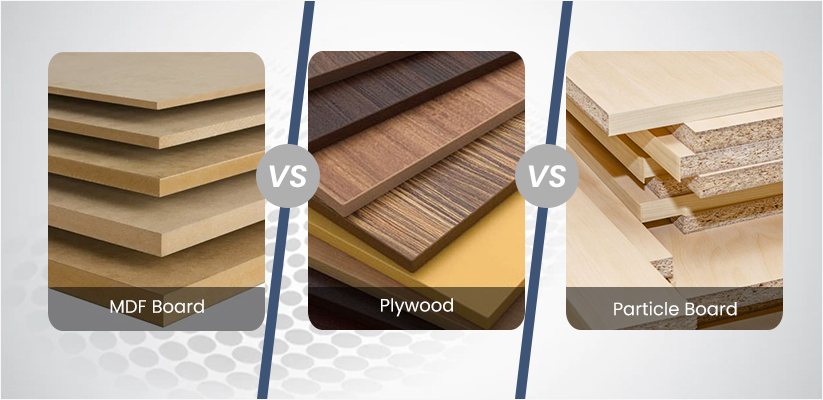
Choosing between MDF, plywood and particle board starts with the job the panel must do. A painted wardrobe door, a supported desk top and a cabinet beside plumbing have different demands. Comparing only the cheapest sheet can lead to a more expensive finished project.
Where MDF fits
MDF has a fine, uniform core that works well for painted surfaces and routed profiles. It can be useful for decorative cabinet fronts and interior panels with shaped details. Finishing the edges properly matters because they absorb finishing materials differently from the faces.
Consider the weight of large components and select hinges or supporting frames accordingly. Standard MDF should be protected from water, and any moisture resistant option should be specified by grade rather than assumed from its colour.
Where plywood fits
Plywood consists of bonded veneer layers. Its performance depends on the veneer species, construction, bonding quality and grade. It can suit furniture and joinery where the required product has appropriate mechanical and moisture performance.
Inspect the edges and faces, ask about internal voids and confirm the intended application. The word plywood alone is not a structural specification, and ordinary furniture plywood should not automatically be used for load bearing construction or concrete formwork.
Where particle board fits
Particle board uses bonded wood particles and is commonly considered for economical, supported interior furniture. A laminated face can provide a practical finished surface for desks, storage units and cupboards. Hardware choice and fixing methods deserve attention, particularly when furniture will be moved or dismantled.
Avoid treating all particle boards as identical. The grade, thickness, density and finish affect the intended use. Exposed edges and wet areas still need protection.
Compare an actual design
Ask a carpenter to price one design using suitable specifications for each material. Include sheet waste, edging, finishing, hardware, labour and transport. A lower sheet price may be offset by additional finishing, while a more expensive board may reduce a particular workshop process.
For example, a painted decorative front may favour MDF, while another component may call for a specified plywood grade. A supported storage carcass may meet the brief with laminated particle board. Combining materials can be sensible when each part has a clear purpose.
Make the decision on evidence
Bring the dimensions, intended load, room conditions and preferred finish to Comply when requesting options. Ask which available products meet those requirements and compare like for like quotations. The best board is the one that fits the design and conditions at an acceptable completed cost.